
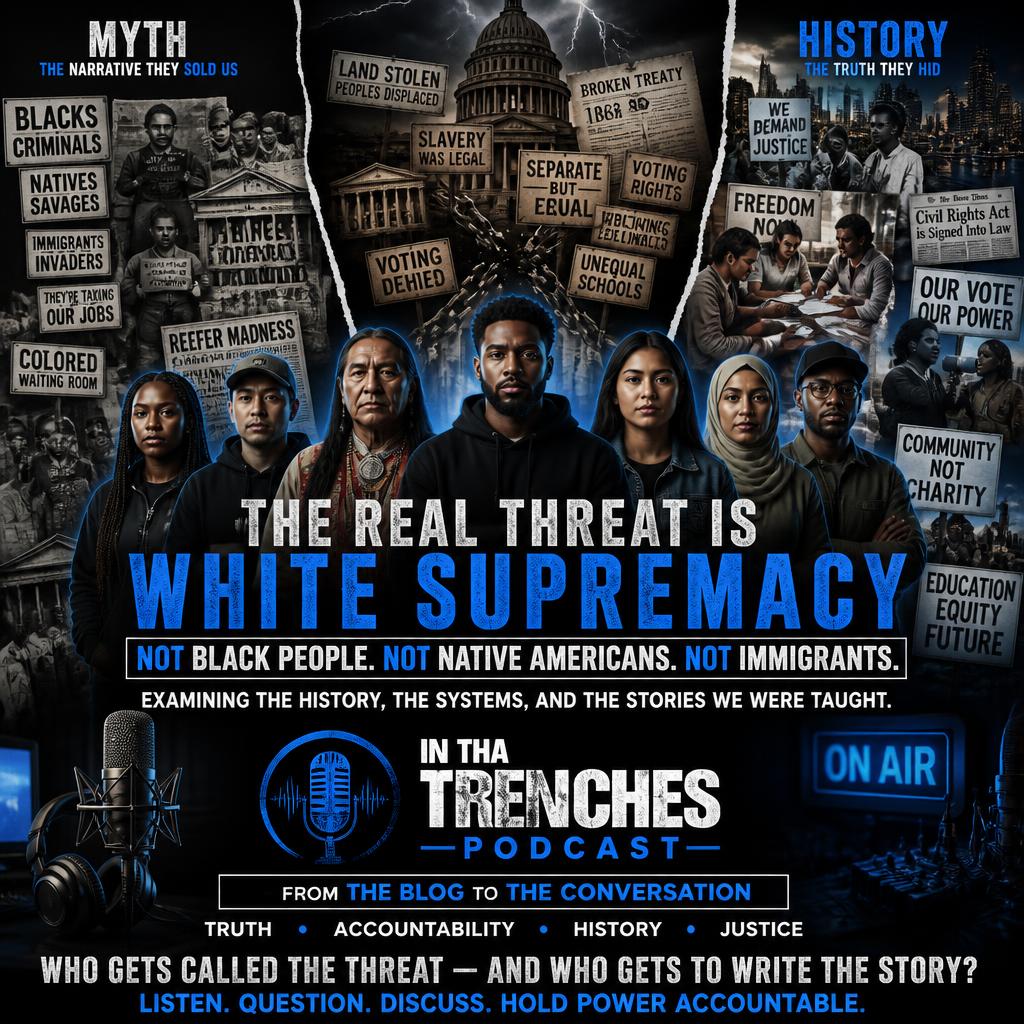
For generations, Black people, Native Americans, immigrants, and other marginalized communities have been portrayed as threats to society. They have been labeled criminals, savages, invaders, outsiders, and burdens. Meanwhile, the violence committed by powerful white institutions has often been softened, justified, or erased.
The problem is not that every white person is evil. The problem is a system of racial power that has repeatedly allowed conquest, exploitation, and violence to be presented as civilization, progress, law, or heroism.
Rewriting Violence as Heroism
Many nations teach history through the eyes of those who held power. In the United States and other Western countries, settlers and military leaders are often presented as brave pioneers, nation-builders, or defenders of freedom. Yet the same stories may minimize the displacement of Native nations, the seizure of land, broken treaties, forced assimilation, and the destruction of Indigenous communities.
The people who resisted invasion are then portrayed as violent or uncivilized. Their defense of their homes becomes “rebellion,” while the taking of their land becomes “expansion.”
This pattern is not accidental. When the dominant group controls the government, schools, newspapers, publishing industry, film studios, and museums, it often has the power to decide whose actions are remembered as noble and whose actions are condemned.
The Myth of Innocence
Racial power frequently protects itself through a false image of innocence. Violence committed by white individuals or institutions may be described as an isolated mistake, a tragic necessity, or the action of a few bad people. Violence committed by people of color is more likely to be treated as proof that an entire community is dangerous.
This double standard appears in news coverage, political speeches, entertainment, and public policy. A white perpetrator may be described as troubled, alienated, or mentally ill, while a Black or immigrant suspect may be described as representative of a larger criminal culture.
The result is a society that often demands collective responsibility from oppressed communities while granting individual excuses to those associated with the dominant group.
Hollywood’s Favorite Hero
Television and movies have helped reinforce this imbalance. Countless stories place white characters at the center of struggles that were originally led, shaped, or survived by people from other cultures.
Indigenous knowledge is absorbed into stories that center white explorers. Black history is retold through fictional white rescuers. Asian, Latino, African, and Middle Eastern characters are often reduced to stereotypes, villains, servants, comic relief, or background figures.
Even when people of color are included, their experiences may be filtered through a white character’s perspective. The audience is encouraged to identify with the white observer rather than with the people whose lives are actually at the center of the story.
This is one way cultural erasure works. It does not always require removing people completely. Sometimes it means allowing them to appear while denying them leadership, complexity, intelligence, or heroism.
Who Is Called a Threat?
Black communities have been targeted by discriminatory policing, mass incarceration, housing segregation, and economic exclusion. Native Americans have faced dispossession, broken treaties, cultural suppression, and the theft of children from their families. Immigrants are frequently blamed for unemployment, crime, overcrowded schools, or political instability—even when economic and social problems are caused by broader policies and decisions made by those in power.
Yet the public conversation often focuses on whether these communities belong, deserve assistance, or should be controlled.
That question should be reversed.
Instead of asking why marginalized people are angry, poor, displaced, or protesting, society should ask what historical conditions produced those realities. Instead of treating immigrants as invaders, we should examine the wars, economic policies, political interventions, and labor demands that have shaped migration. Instead of describing Indigenous resistance as savagery, we should acknowledge that people have the right to defend their land, families, and culture.
Accountability Without Collective Blame
Criticizing white supremacy is not the same as condemning every white person. Many white people have opposed racism, supported civil rights, defended Indigenous sovereignty, welcomed immigrants, and worked alongside communities fighting injustice.
But solidarity requires honesty. People cannot oppose racism while denying the history of racial privilege, colonial violence, or the continuing influence of those systems. Good intentions do not erase unequal outcomes, and silence often protects the status quo.
The goal should not be revenge against one racial group. The goal should be accountability, truth, repair, and equality. That means telling history accurately, supporting diverse storytellers, challenging racist stereotypes, protecting voting and civil rights, and refusing to confuse the identity of an individual with the behavior of a system.
The real danger is not the existence of people from one race. The danger is any ideology that ranks human beings by race, excuses violence when committed by the powerful, and then blames the victims for the conditions imposed upon them.
A just society must stop asking marginalized communities to prove their humanity. It must start examining the institutions, stories, and power structures that have denied it.
