
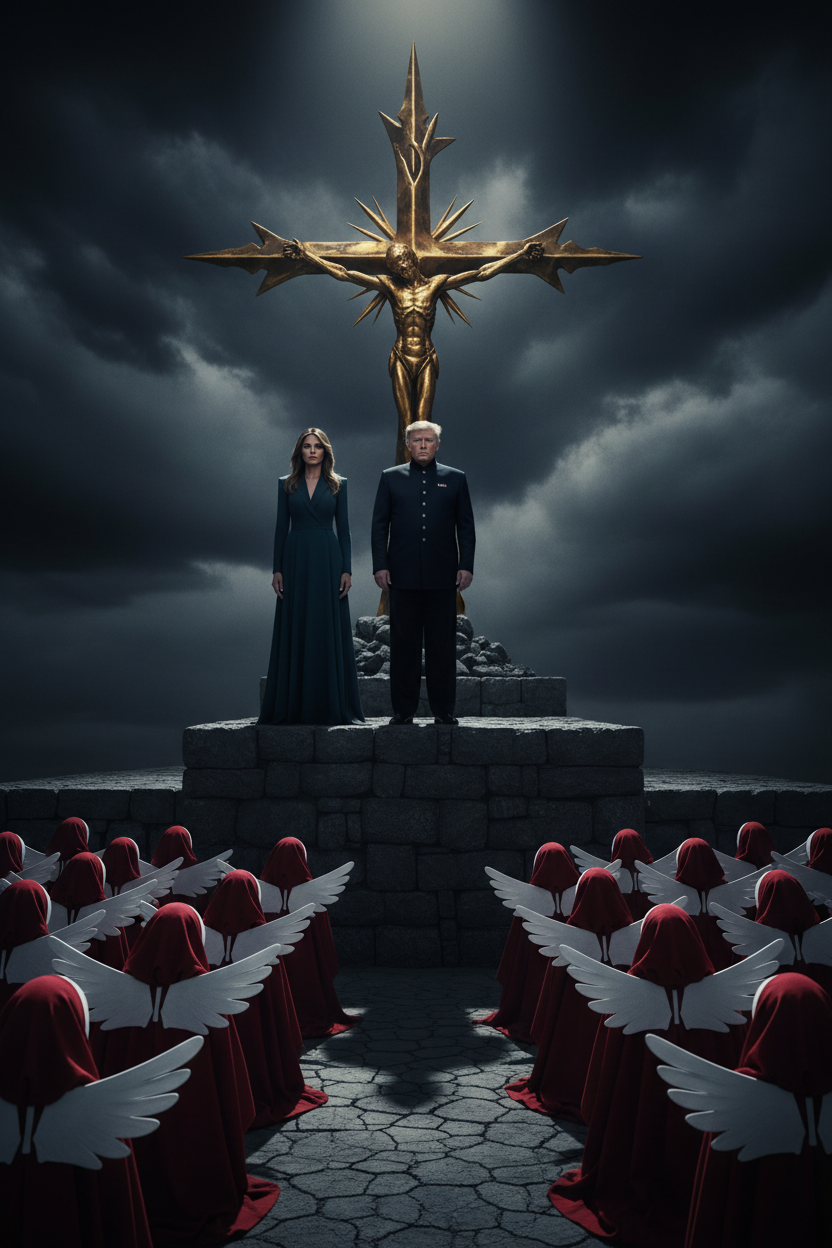
Trump, Money, Lies, and Political Idolatry
Donald Trump’s political style combines personal branding, repeated false or misleading claims, family financial interests, attacks on independent institutions, and demands for personal loyalty. A responsible critique should focus on documented conduct and institutional evidence—not make unsupported claims about every Trump supporter, Republican, or Christian.
The Leader as a Brand
Trump has often treated public office as an extension of his personal brand.
NBC News reported that his administration promoted efforts to place his name or image on federal buildings, government programs, websites, currency, and military-related institutions. The Kennedy Center also became the subject of a dispute over adding Trump’s name to the institution; in August 2026, the board delayed further naming efforts while legal challenges continued.nbcnews+1
A president’s name on a public building may appear symbolic, but symbols communicate political values. Public institutions are supposed to belong to the nation and its people, not to one president or family.
When a leader repeatedly attaches his name to public institutions, the message can become:
The institution exists because of me, and its identity should reflect me.
This is the foundation of personality-centered politics. The leader becomes more important than the office. Loyalty to the individual becomes more important than loyalty to the Constitution, the law, or the public.
It is not appropriate to make a clinical diagnosis of Donald Trump without a professional evaluation. However, his public political style can be analyzed as displaying narcissistic traits: grandiosity, constant self-promotion, extreme sensitivity to criticism, a demand for personal loyalty, and a tendency to claim credit for success while blaming others for failure.
A self-centered private individual may damage personal relationships. A self-centered political leader can damage institutions, elections, courts, agencies, alliances, and public trust.
Money and Public Trust
There is no single, audited total proving that Donald Trump “stole” a specific amount of money from the American people. That phrase combines different categories—taxpayer spending, private business income, court-ordered damages, and estimated cryptocurrency gains—that cannot responsibly be added together.
The documented financial picture is still serious.
During Trump’s first presidency, House Oversight investigators reported more than $1.4 million in Secret Service spending at Trump-owned properties and warned that the available records might be incomplete. Later reviews identified nearly $2 million in Secret Service payments to Trump businesses based on government records and prior reporting.oversightdemocrats.house+1
The ethical concern is straightforward: taxpayers were paying to protect the president while some of that public money flowed into businesses connected to the president and his family.
The Trump Foundation also faced legal consequences. In 2019, a New York court ordered Trump to pay $2 million in damages for improperly using charitable assets. That ruling did not establish that every Trump charitable donation was fraudulent, but it did establish that a court found improper use of charitable funds.ny
Trump’s business statements have faced additional legal scrutiny. A New York trial court found Trump and his companies liable for financial fraud. An appellate court later eliminated the large monetary penalty, while the underlying fraud findings and other legal consequences remained part of continuing litigation.ny+1
The most recent and largest financial concern involves cryptocurrency. Trump’s 2025 financial disclosure reported more than $1.4 billion in income from family crypto ventures. The New York Times reported that Trump’s total 2025 income was at least $2.2 billion, including real-estate and cryptocurrency-related income. Reuters separately estimated that the Trump family had gained at least $2.3 billion from its major crypto ventures while other investors experienced comparable losses, including paper losses, by the end of April 2026.reuters+2
These figures overlap. The $1.4 billion in crypto income is included within the larger income picture, and the $2.3 billion estimate concerns family gains rather than money proven to have been taken from American taxpayers.
The most accurate conclusion is therefore not that Trump has been proven to have stolen a specific total from the American people. The defensible conclusion is that his political career has produced an extraordinary overlap between public power, private businesses, family enrichment, and weak ethics protections.
A conflict of interest does not require proof that every government decision was personally purchased. The conflict exists when public authority and private financial benefit overlap in ways that can undermine public trust.
Lies, Loyalty, and the Military
Fact-checkers have documented thousands of false or misleading statements by Trump. The Washington Post counted 30,573 false or misleading claims during his first presidential term.washingtonpost
One of the most consequential examples was the repeated claim that the 2020 election was stolen through widespread fraud. Fact-checkers, election officials, courts, federal agencies, and members of Trump’s own administration found no evidence that widespread fraud changed the outcome.factcheck
The problem was not simply that a politician made an incorrect prediction. The problem was that the claim continued after evidence disproved it.
Trump-centered politics often transforms truth into a loyalty test:
If Trump wins, he deserves all the credit.
If he loses, the election must have been rigged.
If courts rule for him, the courts are legitimate.
If courts rule against him, the courts are corrupt.
If journalists praise him, they are credible.
If journalists criticize him, they are enemies.
If former allies support him, they are patriots.
If former allies expose misconduct, they are traitors.
This system does not encourage independent judgment. It encourages emotional loyalty.
Supporters may continue defending a leader after repeated failures because admitting the truth would require admitting that they trusted the wrong person. A movement becomes trapped when it cannot admit that its leader was wrong.
The same concern applies to the military.
It would be inaccurate to say that Trump has literally destroyed the United States military. The country still has a large, funded, operational military. However, documented personnel changes and budget disputes have raised concerns about politicization, institutional stability, and whether loyalty to the president is being valued above professional independence.
The Associated Press reported that Trump dismissed the chairman of the Joint Chiefs of Staff and replaced him with his own choice, while other senior military officials were also removed or replaced. AP described these actions as creating risks of politicizing the military.apnews
The Pentagon also directed military leaders to identify approximately $50 billion in potential reductions for fiscal year 2026 so that funds could be redirected toward Trump’s defense priorities. Budget changes are not automatically evidence of destroying the military. The concern is whether personnel decisions and budget changes are based on national-defense needs or personal and political loyalty.reuters
A professional military depends on:
Competence.
Constitutional obedience.
Nonpartisan leadership.
Independent legal advice.
Institutional memory.
Honest assessments.
Respect for civilian authority without personal worship.
If military leaders believe their careers depend on praising a president, they may become less willing to provide unwelcome information. That weakens national security because leaders need accurate assessments, not flattery.
The military should serve the Constitution and the nation—not one person’s political brand.
Hitler, MAGA, and Extremism
Comparing Trump with Adolf Hitler requires historical precision.
Trump is not literally Hitler. Nazi Germany was a totalitarian dictatorship responsible for World War II and the Holocaust. The scale, ideology, state structure, and crimes of the Nazi regime were historically unique. Holocaust educators have warned that careless comparisons can trivialize the murder of six million Jews and millions of other victims.
Nevertheless, historical comparison can be useful when it identifies political warning signs rather than claiming exact equivalence.
Those warning signs may include:
A leader claiming that only he can save the nation.
Scapegoating minorities and immigrants.
Attacking independent journalism.
Claiming that elections are legitimate only when he wins.
Demanding personal loyalty.
Treating opponents as enemies of the nation.
Weakening independent institutions.
Using nationalist grievance to justify extraordinary power.
Scholars continue to debate whether Trump’s movement should be described as authoritarian, populist, fascistic, or something else. The most responsible approach is to compare political methods while acknowledging the differences between contemporary American politics and Nazi Germany.
The question is not whether Trump is a reincarnation of Hitler. The question is whether Americans recognize dangerous patterns before they become irreversible.
MAGA and neo-Nazism are also not identical categories.
Neo-Nazi groups embrace or adapt Nazi racial ideology, antisemitism, authoritarianism, and racial nationalism. The Anti-Defamation League identifies organizations such as The Base as neo-Nazi groups that promote Hitlerian ideology and race war.
Some far-right online spaces associated with “Dark MAGA” have used fascist and neo-Nazi symbols. That overlap deserves investigation, especially when extremists believe that mainstream political rhetoric creates an environment favorable to their ideas.
But it is inaccurate to call every MAGA voter a neo-Nazi.
A more defensible statement is:
Some neo-Nazi and white-nationalist actors have attempted to influence or attach themselves to the broader MAGA ecosystem, while some MAGA rhetoric has created openings that extremists interpret as useful.
The responsibility of ordinary supporters is to decide what they will tolerate. If a movement attracts white supremacists, political violence, antisemitic conspiracy theories, or authoritarian symbolism, supporters should reject those elements clearly rather than dismissing every criticism as an attack.
Silence can create permission.
When Faith Becomes Political Idolatry
Not all Christians support Trump, and not all Trump supporters are Christian nationalists.
Christian nationalism is a political ideology that joins national identity with a preferred version of Christianity and often seeks to give that identity special influence over government. Research has found a strong relationship between Christian-nationalist beliefs and favorable views of Trump.
The spiritual contradiction appears when political loyalty becomes more important than truth, humility, mercy, justice, and care for vulnerable people.
Many Christian teachings emphasize humility, honesty, compassion, forgiveness, restraint, and resistance to pride. A political movement that excuses dishonesty, cruelty, greed, revenge, and personal glorification may be using Christian symbols while violating the moral principles it claims to defend.
From a Christian theological perspective, critics may describe the elevation of a political leader above truth and moral accountability as idolatry. This does not mean that every Trump supporter literally worships him. It means that the nation, the leader, or the movement can become more important than God and more authoritative than moral principles. Scholars have warned that Christian nationalism can replace religious ethics with political identity.
A leader who demands absolute loyalty is not asking for faith. He is asking for submission.
Christianity does not require believers to defend every action of a political figure. Religious ethics should require honesty about greed, pride, cruelty, exploitation, and false witness—even when those behaviors come from a politician who claims to defend Christianity.
The central danger is not only Donald Trump. It is the willingness of citizens and institutions to excuse conduct that would be condemned in anyone else.
Democracy weakens when:
Public money flows into a president’s private businesses.
Family wealth expands alongside public authority.
False claims continue after evidence disproves them.
Military leaders are judged by personal loyalty.
Public buildings become monuments to one politician.
Extremists are tolerated when politically useful.
Religious leaders confuse political victory with divine approval.
The answer is not hatred of Trump supporters, Republicans, white Americans, or Christians. The answer is evidence, transparency, independent institutions, and equal accountability.
Trump’s name should never become more important than the institution it is placed upon. His wealth should never be treated as proof of virtue. His followers should never be required to choose loyalty over truth. Religious faith should never be used as a shield for corruption, cruelty, or personal power.
A nation is not saved by a leader who demands constant praise.
It is strengthened by citizens who can question leaders, accept evidence, reject political idolatry, and place the Constitution, human dignity, and truth above the ambitions of one family.
