
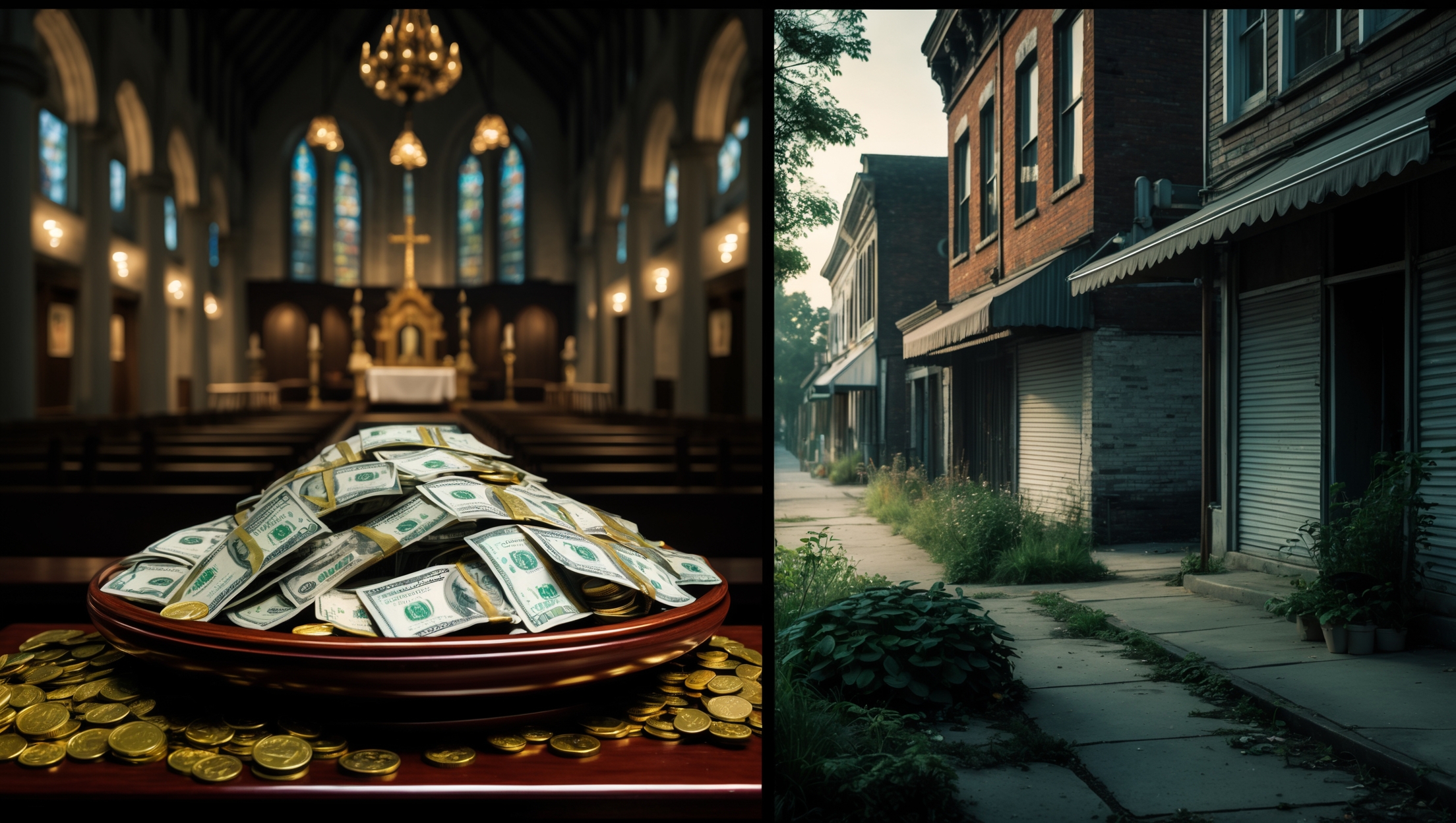
There’s a sacred rhythm to life in many Black neighborhoods, a rhythm once set by the church. It was the heartbeat, the conscience, and the economic engine. From the fiery oratory that fueled the Civil Rights Movement to the quiet deacons who ensured a family had food after a tragedy, the church was in the community and of the community.
But a quiet, troubling question is being whispered in pews and on porches: Has that heartbeat grown faint? Are we witnessing a great divorce between the Black church and the Black community it was built to serve?
The concern is no longer just a whisper; it’s a cry against a growing perception. The perception that the millions of dollars faithfully placed in offering plates each Sunday are being funneled into financial systems that do not reinvest in our neighborhoods. That the funds are deposited in non-Black-owned banks, which then easily turn around and provide the loans and capital to develop other communities—often white communities—while our own storefronts remain vacant and our dreams of entrepreneurship are deemed “too risky.”
This isn’t just a financial critique; it’s a spiritual one. It strikes at the very identity of the church.
The Foundation That Was
The Black church was never just a place of worship; it was a fortress of survival and a launchpad for prosperity. It understood the biblical mandate of stewardship in the most practical terms. The church built schools, funded businesses, and created mutual aid societies. It was the ultimate example of what it means to “love your neighbor as yourself” (Mark 12:31).
The philosophy was simple but powerful: we take care of our own because we are our brother’s keeper. This was a direct application of Christian principles to material reality. The Apostle Paul wrote to the Galatians, “Therefore, as we have opportunity, let us do good to all people, especially to those who belong to the household of faith.” (Galatians 6:10). The early church saw its resources as a tool for building up the community of believers, first and foremost.
The Shift: In the World, and Now Of the World
There’s an old saying many of us heard from our elders: “You are born in the world, but that does not mean you have to be of the world.” It was a warning against adopting the values of a system opposed to God’s kingdom.
The critique many level today is that the church has not just entered the world; it has become of the world. The primary measure of success has shifted from spiritual impact to financial accumulation. The word of God, some argue, is being supplanted by the word of Money. The prophet Jeremiah issued a stern warning that feels eerily relevant: “Like a cage full of birds, their houses are full of deceit; they have become rich and powerful and have grown fat and sleek. Their evil deeds have no limit; they do not seek justice. They do not promote the case of the fatherless; they do not defend the just cause of the poor.” (Jeremiah 5:27-28)
When the primary goal is to maintain and grow income, the message from the pulpit can soften. The hard truths of the Gospel—justice, repentance, and self-sacrifice—are smoothed over to avoid offending the large tithers. Pastors, who are called to be shepherds, can subtly become CEOs, trusting more in the financial security provided by man than the provision promised by God.
This is a crisis of faith. Jesus himself addressed this directly: “No one can serve two masters. Either you will hate the one and love the other, or you will be devoted to the one and despise the other. You cannot serve both God and money.” (Matthew 6:24). When a church’s financial practices contradict its professed faith, it creates a credibility gap that the community cannot ignore.
The Hypocrisy and the Pedestal
This leads to the painful charge of hypocrisy. Congregants are often quick to place pastors on impossible pedestals, but the leaders themselves can forget their own humanity and their absolute dependence on grace. The result is a performance of perfection that is unsustainable and unbiblical.
The Apostle James gave a sobering instruction to those who would be teachers: “Not many of you should become teachers, my fellow believers, because you know that we who teach will be judged more strictly.” (James 3:1). This isn’t a threat, but a reminder of the immense responsibility that comes with leadership. When the focus shifts to wealth and appearance, it creates a dissonance with the teachings of Christ, who had “no place to lay his head” (Luke 9:58).
This disconnect fuels the rise of what many see as “cultural Christianity,” particularly among some radical conservative circles. People claim the label but fail to embody the heart of Christ. They may quote scripture but ignore its core message of love, justice, and mercy. They have zeal, but as Paul noted, it is “not based on knowledge.” (Romans 10:2). They have not truly studied the scripture to see that their thoughts, actions, and hearts do not match the humble, servant-hearted teachings of the one they claim to follow.
A Call to Return to First Love
This is not a call to abandon the church. It is a call to reclaim it. It is a loving, yet firm, challenge to our spiritual leaders and ourselves.
Re-examine Financial Stewardship: Where are our churches banking? Are we intentionally investing in Black-owned financial institutions that are positioned to lend to our communities? This is a modern-day application of the Parable of the Talents (Matthew 25:14-30)—using resources for growth within the kingdom.
Embrace Prophetic Truth: Pastors must be empowered to preach the whole counsel of God, not just the palatable parts. The church must be a voice for the marginalized, as Jesus was, even when it’s inconvenient.
Remember the Mission: The church is called to be the “salt of the earth” and the “light of the world” (Matthew 5:13-14). Salt that loses its saltiness is worthless. Light is meant to be seen, to illuminate and guide. Our light must shine through tangible, community-building action.
The Black church is too precious an institution to be lost to the seduction of worldly success. Its legacy is one of liberation, both spiritual and economic. It’s time for a conversation, a prayerful movement, to bridge the great divorce and return to our first love: God, and by extension, the community He has called us to serve.
What are your thoughts? Is this a fair assessment? Share your experiences and reflections in the comments below.
